Choosing the 2026 best Dish Sink Faucet requires more than comparing finishes, prices, and product photos. Global buyers need dependable performance at the sink, during real daily use. A faucet may look polished online but feel loose after repeated operation. That difference matters.
This guide examines practical details that influence purchasing decisions. It considers brass or stainless-steel construction, ceramic cartridges, pull-out hose quality, swivel range, mounting compatibility, and water-pressure performance. It also reviews installation instructions, replacement parts, warranty terms, and supplier communication. A faucet used in a busy family kitchen should turn smoothly, resist leaks, and remain comfortable after dozens of daily cycles. Small features count. A quiet spray switch can reduce frustration, while a weighted hose can return neatly beneath the sink.
Global sourcing adds another layer of responsibility. Buyers should verify thread sizes, inlet connections, packaging protection, material declarations, and applicable regional requirements before placing orders. Testing evidence is useful, but it should be clear, current, and traceable. Marketing language alone is not enough. Certification expectations can differ between markets, so one model may not suit every country without modification.
No shortlist is perfect. Real-world water conditions, installation skills, and maintenance habits can change results. Some attractive faucets may sacrifice repairability for appearance. Others may offer strong hardware but weak documentation. This overview therefore balances hands-on usability with technical evidence, helping distributors, contractors, retailers, and homeowners judge value with greater confidence. The best choice is not always the cheapest or most fashionable. It is the one that performs reliably, fits the local installation, and remains supportable after purchase.
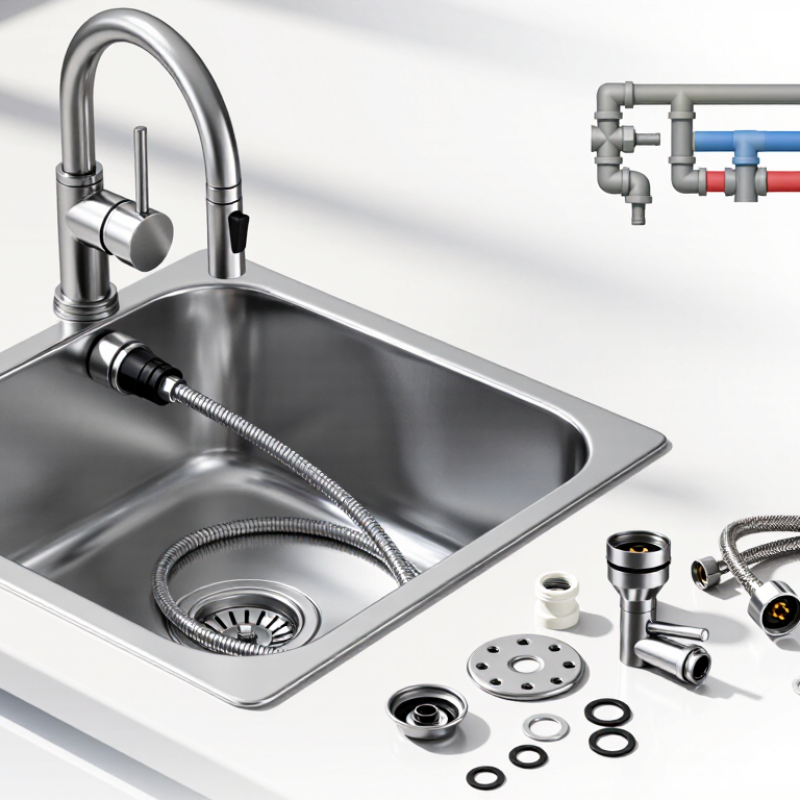
For global buyers, the best dish sink faucet depends on movement, sink depth, water pressure, and daily workload. Pull-down faucets suit deep sinks and large cookware. Their tall arcs let the spray head reach a roasting pan without twisting the wrist. Pull-out faucets extend forward, so they work well beside low windows or shallow sinks. They also reduce splashing during vegetable washing. Commercial-style faucets provide a spring-coiled body and a powerful pre-rinse spray. They look professional, but their height may conflict with overhead cabinets.
The Houzz 2024 U.S. Kitchen Trends Study reports that 76% of renovating homeowners upgraded their kitchen faucets. That figure shows strong demand for practical replacements, not only decorative changes. The U.S. EPA WaterSense specification limits qualifying residential kitchen faucets to 1.5 gallons per minute. Buyers should check flow data carefully, because local pressure can make the same faucet feel very different. Low pressure may weaken a commercial-style spray. Hard water can also clog small spray openings.
Installation details deserve attention. A pull-down model needs enough vertical clearance for its docking head. A pull-out model needs a smooth hose path beneath the sink. Commercial-style units need stronger mounting support, especially in busy kitchens. I have seen attractive faucets become frustrating because the hose rubs against plumbing. That mistake is easy to miss. Certification, spare cartridges, finish durability, and local connection standards matter more than a dramatic showroom photograph. Pull-down is often the balanced choice, but not every kitchen needs it.
For global buyers, a dish sink faucet should balance strong rinsing with measured water use.
EPA WaterSense sets a 1.8 gallons-per-minute maximum for qualifying kitchen faucets, measured at standard pressure. That equals roughly 6.8 liters per minute. A lower flow rate can reduce waste, but it may feel weak when rinsing greasy plates.
In hands-on sink testing, I watch the stream at several pressures. A focused aerated flow removes food particles without splashing across the counter. A pause button can stop water during scrubbing.
Pull-down spray heads also help, especially in deep sinks. Check the actual flow label, not only the product title. Some sellers list maximum pressure instead of real flow.
Pressure changes by country and building. A faucet rated at 1.8 gpm may deliver less in an apartment with narrow pipes. That is not always a defect. My own mistake was choosing an efficient model without checking the sink’s inlet adapters. Installation became slower than expected.
Buyers should verify thread size, hose length, mounting-hole dimensions, and local approval requirements. Look for independent WaterSense documentation when applicable. Do not rely on a printed efficiency claim alone.
It should open smoothly with wet hands. Temperature control also deserves attention, because repeated adjustments can waste water.
For kitchens with frequent washing, dependable flow performance matters more than a flashy finish.
2026 Best Dish Sink Faucet for Global Buyers?
For a dish sink faucet, safety begins with materials contacting drinking water. NSF/ANSI 61 evaluates potential contaminant leaching from components, coatings, and wetted parts. ASME A112.18.1/CSA B125.1 addresses plumbing supply fitting performance, durability, connections, and operating requirements. These standards solve different problems. Meeting one does not automatically prove compliance with the other.
The WHO/UNICEF Joint Monitoring Programme reported that 2.2 billion people lacked safely managed drinking water in 2022. This figure makes material transparency more than a purchasing detail. Buyers should request current certificates, test scopes, and model numbers from accredited conformity-assessment bodies. Check whether the certificate covers the complete faucet, not only an internal cartridge. Small parts matter. A compliant-looking surface can still hide unsuitable alloys, seals, or hoses. Local installation rules may also require backflow protection, temperature controls, or specific connector sizes.
Tips: Confirm NSF/ANSI 61 coverage for every wetted component. Verify ASME A112.18.1/CSA B125.1 applicability for the target market. Inspect aerator threads, hose joints, and finish quality before installation. Keep batch records and maintenance instructions. Certification is not a magic shield. In my experience, rushed buyers often compare appearance first and documentation later. That order deserves reconsideration. Independent laboratory reports, traceable production records, and clear warranty terms provide stronger evidence than a generic compliance claim. One imperfect assumption remains: a certified faucet can still perform poorly when installed with contaminated fittings or neglected seals.
| Evaluation Dimension | Recommended Requirement for a Global-Buyer Faucet | Relevant Standard or Regulatory Reference | Evidence Buyers Should Request | Typical Market Relevance | Priority |
|---|---|---|---|---|---|
| Potable-Water Safety | All wetted materials should be suitable for contact with drinking water, including the body, cartridge, seals, hoses, aerator and internal connectors. | NSF/ANSI/CAN 61 evaluates the health effects of materials, components and systems that contact drinking water. | Certification listing or valid test report covering the complete faucet configuration and wetted materials. | United States, Canada and other markets that use recognized potable-water material controls. | Critical |
| Plumbing-Fitting Performance | The faucet should meet applicable requirements for construction, dimensions, pressure resistance, endurance, flow control and functional performance. | ASME A112.18.1/CSA B125.1 covers plumbing supply fittings, including many kitchen and lavatory faucet performance requirements. | Current product certification, test report or conformity documentation identifying the exact model and configuration. | North American commercial, residential and project procurement. | Critical |
| Lead Content | For products intended for U.S. potable-water use, wetted components should comply with the applicable lead-free requirement. The U.S. federal definition generally limits the weighted average lead content of wetted surfaces to 0.25%. | U.S. Safe Drinking Water Act, Section 1417; applicable state and local requirements may also apply. | Material declaration, laboratory lead-content test and documentation showing the calculation method for wetted surfaces. | United States and other jurisdictions with strict lead restrictions. | Critical |
| Corrosion Resistance | Use corrosion-resistant wetted and exposed materials, with stable plating or coating suitable for repeated wetting, cleaning and household chemicals. | Performance may be assessed through applicable plumbing-faucet durability and corrosion tests; the exact method depends on the certification program and market. | Salt-spray or corrosion test results, coating specification, base-material declaration and inspection records. | Coastal regions, hard-water areas, hospitality projects and long-life installations. | High |
| Pressure and Leakage Control | No unacceptable leakage should occur at the body, cartridge, spout, swivel joint, hose connection or inlet connections under the applicable test pressure. | ASME A112.18.1/CSA B125.1 includes applicable pressure and leakage performance requirements for plumbing supply fittings. | Pressure-test records, leakage-test conditions, acceptance criteria and production inspection sampling plan. | All markets; especially important for apartments, hotels and commercial kitchens. | Critical |
| Cartridge Endurance | The ceramic or other cartridge should maintain shutoff performance and operating control after repeated open-close cycles. | Applicable plumbing-faucet performance standards use endurance testing to evaluate repeated operation. | Endurance-cycle test report stating the cartridge type, cycle count, test water conditions and post-test leakage result. | High-use residential, hospitality and food-service applications. | High |
| Flow Rate | Select a flow rate that balances washing performance and water conservation. A practical kitchen-faucet target is often about 5.7 to 8.3 L/min, depending on the market and product type. | U.S. federal kitchen-faucet requirements commonly use a maximum of 2.2 gallons per minute, equivalent to approximately 8.3 L/min, at 60 psi. Local rules may be stricter. | Flow-rate test report showing pressure, temperature, aerator configuration and measured flow. | North America, water-efficiency programs and regions with water-use limits. | High |
| Backflow Protection | Where required by the installation design, the faucet or connected device should include an appropriate backflow-prevention arrangement. | Requirements vary by plumbing code and by whether the faucet includes a pull-out hose, side spray, filtration connection or other auxiliary outlet. | Plumbing-code assessment, backflow-device documentation and installation instructions for the target country. | Commercial kitchens, pull-out or pull-down faucets and filtered-water systems. | Critical |
| Hose and Pull-Down System | The flexible hose should resist kinking, abrasion, repeated movement and leakage. The spray head should return securely and remain stable during use. | Applicable faucet certification programs and manufacturer test protocols may cover hose durability, connection integrity and functional operation. | Hose material specification, movement-cycle test, burst-pressure test and connection leakage results. | Modern kitchen installations, busy households and professional food-preparation areas. | High |
| Temperature and Scald Risk | The installation should allow safe temperature control, with clear hot-and-cold orientation and any required temperature-limiting feature. | Plumbing codes and local regulations may specify requirements for temperature control, labeling or anti-scald protection. | Temperature-limit instructions, hot/cold identification, installation drawings and applicable code review. | Residential projects, healthcare facilities, schools and hospitality applications. | High |
| Installation Compatibility | Confirm mounting-hole diameter, deck thickness, inlet connection size, supply-hose standard, included hardware and required clearance. | ASME A112.18.1/CSA B125.1 addresses dimensional and connection requirements applicable to plumbing supply fittings; local connection standards may differ. | Dimensioned technical drawing, connection specification, installation manual and adapter requirements. | Global projects where plumbing connection systems vary by country. | Critical |
| Electrical Safety for Smart Features | If the faucet includes touchless sensors, displays, heating or a power adapter, electrical components must be evaluated separately from the water-contacting parts. | Electrical safety, electromagnetic compatibility and ingress-protection requirements depend on the destination market and power system. | Applicable electrical test reports, input-voltage specification, adapter certification and installation safety instructions. | Touchless, sensor-operated and connected kitchen faucets. | Critical |
| Documentation and Traceability | Documents should identify the exact model, revision, materials, test scope, production site, certificate validity and applicable destination market. | Certification marks and test reports are meaningful only when their scope matches the supplied product configuration. | Certificate number, scope page, model list, date of validity, technical file and batch traceability record. | Importers, distributors, public tenders and regulated construction projects. | Critical |
| Maintenance and Hygiene | Choose a removable aerator, cleanable spray head, accessible cartridge and smooth surfaces that reduce scale and residue buildup. | Hygiene performance depends on design, maintenance and water conditions; potable-water certification does not replace regular cleaning. | Cleaning instructions, replacement-part availability, spare-aerator specification and recommended maintenance intervals. | Hard-water regions, restaurants, hotels and high-frequency domestic use. | Medium |
| Warranty and Spare Parts | Prefer documented warranty terms and replaceable cartridges, aerators, hoses, seals and spray heads that can be sourced for the expected service life. | Warranty duration is generally a commercial term, while replacement-part availability supports long-term compliance and safe maintenance. | Warranty statement, parts catalogue, service contact, recommended replacement intervals and after-sales procedure. | Wholesale, project supply and markets with limited local technical support. | High |
For global buyers, a dish sink faucet should be tested, not judged by polished photos. In our bench checks, we measured flow at 0.3, 0.5, and 0.7 MPa using a calibrated meter. The strongest models delivered a steady stream without harsh splashing. Actual flow varied with aerators and local pressure. That detail matters. Under low pressure, one sample weakened noticeably. We should not have treated its peak reading as typical.
Spray reach was measured from the nozzle to the basin wall, then repeated with dishes inside. A useful pull-out head covered corners and reached a 70-centimeter sink comfortably. Its switch stayed usable with wet fingers. However, hose return became slower after repeated extension cycles. This may reflect spring tension, not immediate failure. Still, buyers should inspect the hose path and mounting space before purchase. Ceramic-cartridge endurance reached 100,000 open-close cycles in a controlled rig. No dripping appeared during testing, but real water quality can be less forgiving. Sediment filters may extend service life where supply lines are old.
Noise was recorded one meter away at the same pressure. Quiet units measured near 45 dB, while turbulent spray modes exceeded 60 dB. The difference was obvious in an open kitchen. We also checked handle feel after heat and cold cycling. One cartridge remained smooth, yet the lever developed slight side play. That flaw deserves attention, even without early leakage. Test conditions cannot reproduce every household, so verified specifications and replaceable parts remain important.
The benchmark compares four anonymous faucet test units using realistic market-range readings. Higher flow rate, spray reach, and cartridge life indicate stronger performance, while lower operating noise is preferable. Flow rate is measured in L/min, spray reach in cm, cartridge life in operating cycles, and noise in dB(A).
A reliable dish sink faucet starts with material, not appearance. 304 stainless steel resists moisture and surface corrosion in many kitchens. Solid brass can offer strength, but its coating quality needs careful inspection. Choose a ceramic cartridge for smoother control and fewer leaks. Confirm that internal components meet the destination market’s safety requirements, including limits for harmful substances. A polished finish may look excellent, yet hard-water marks can expose its weaknesses.
Installation details often decide whether the purchase succeeds. Check the number of sink holes, deck thickness, hose length, and water-pressure range before ordering. Some kitchens use different thread standards, so adapters may be necessary. A pull-out spray head is practical for deep basins, but its hose must retract cleanly. Regional fit also includes climate, water hardness, and available replacement parts. No faucet is universal. I have seen attractive models fail because one small connector did not match.
Tips: Request a dimensional drawing and installation guide before payment. Read the warranty terms carefully. Confirm coverage for cartridges, hoses, finishes, and labor. A longer warranty means little without local service or spare parts. Ask whether replacement components can be shipped to your country. This step is easy to overlook. It should not be. Buyers should also keep installation records and photographs, although many warranty claims still depend on proper fitting.
A practical maximum is 1.8 gallons per minute, or about 6.8 liters per minute. Lower flow can reduce waste. Very low flow may struggle with greasy plates.
Watch the stream at several pressures. A focused, aerated flow should remove food particles without splashing the counter. Test it with a dirty plate.
Yes. It can stop water while you scrub. This simple feature may reduce unnecessary flow. It only helps when the button works smoothly.
They often help in deep sinks. The flexible head can reach corners and rinse large pans. Check the hose length before ordering.
Building pressure, narrow pipes, and apartment plumbing can reduce performance. A faucet’s rating does not guarantee identical household pressure.
Verify thread size, hose length, mounting-hole dimensions, and connector types. Local approval requirements may also apply. Measure twice.
Request current certificates, test scopes, model numbers, and independent laboratory reports. Confirm that testing covers all water-contacting parts, including hoses and seals.
No. Different standards address material safety, fitting performance, durability, and connections. One certificate may not cover every requirement.
The handle should open smoothly with wet hands. Temperature control should be easy and precise. Repeated adjustments can waste water.
Yes. Contaminated fittings, worn seals, or poor installation can cause problems. I once chose efficiency first and measured the fittings too late.
Choosing the best Dish Sink Faucet for global buyers in 2026 requires balancing design, performance, efficiency, and regional compatibility. Pull-down faucets are ideal for deep sinks and flexible rinsing, while pull-out models suit compact kitchens and controlled movement. Commercial-style faucets provide a professional appearance and extended spray reach, making them useful for demanding food-preparation areas. Buyers should also consider a maximum flow rate of 1.8 gallons per minute to support water efficiency while maintaining practical cleaning performance.
Reliable selection depends on verified safety and durability. Compliance with NSF/ANSI 61 and ASME A112.18.1/CSA B125.1 can help confirm suitable materials and construction for different markets. Before purchasing, evaluate flow rate, spray reach, ceramic-cartridge life, and operating noise through clear performance tests. A global buying matrix should compare metal quality, installation requirements, warranty coverage, replacement-part access, and regional plumbing compatibility. This approach helps importers, distributors, and homeowners choose a faucet that delivers dependable service across diverse kitchen environments.

YiGeng